Appearance
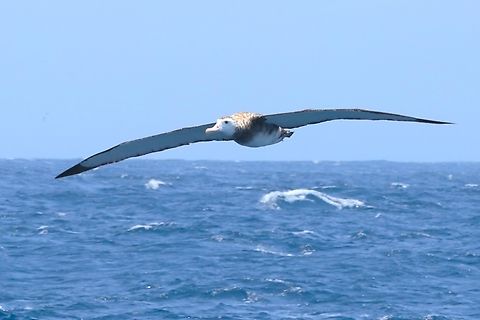
The plumage varies with age, with the juveniles starting chocolate brown. As they age they become whiter. The adults have white bodies with black and white wings. Males have whiter wings than females, with just the tips and trailing edges of the wings black. The snowy albatross is the whitest of the wandering albatross species complex, the other species having a great deal more brown and black on the wings and body, very closely resembling immature wandering albatrosses. The large bill is pink, as are the feet. They also have a salt gland that is situated above the nasal passage and helps desalinate their bodies, due to the high amount of ocean water that they imbibe. They excrete a high saline solution from their nose, which is a probable cause for the pink-yellow stain seen on some animals' necks.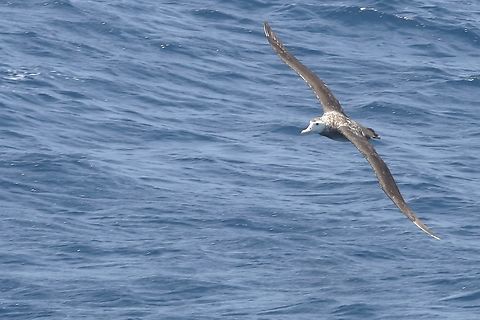
Distribution
The snowy albatross breeds on South Georgia Island, Crozet Islands, Kerguelen Islands, Prince Edward Islands, and Macquarie Island, is seen feeding year-round off the Kaikōura Peninsula on the east coast of the South Island of New Zealand, and ranges in all the southern oceans from 28° to 60°. Some individual snowy albatrosses are known to circumnavigate the Southern Ocean three times, covering more than 120,000 km, in one year.Status
The IUCN lists the snowy albatross as vulnerable status. Adult mortality is 5% to 7.8% per year as of 2003. It has an occurrence range of 64,700,000 km2, although its breeding range is only 1,900 km2.The biggest threat to their survival is that they are attracted by the bait for longline fishing and get caught in the same way as the fish; however, pollution is also taking a toll, mainly from plastics and abandoned fishing hooks. The CCAMLR has introduced measures to reduce bycatch of albatrosses around South Georgia by 99%, and other regional fishing commissions are taking similar measures to reduce fatalities. The Prince Edward Islands are a nature preserve, the Macquarie Islands are a World Heritage site, and large parts of the Crozet Islands and the Kerguelen Islands are nature reserves.
Habitat
Snowy albatrosses spend most of their life in flight, landing only to breed and feed. Distances traveled each year are difficult to measure, but one banded bird was recorded traveling 6,000 km in twelve days.Reproduction
The snowy albatross mates for life and breeds every other year. At breeding time they occupy loose colonies on isolated island groups in the Southern Ocean. When courting they will spread their wings, wave their heads, and rap their bills together while braying. Wanderers have a large range of displays from screams and whistles to grunts and bill clapping. They lay one egg that is white, with a few spots, and is about 10 cm long. They lay between 10 December and 5 January. The nests are large bowls built of grassy vegetation and soil peat, that is 1 meter wide at the base and half a meter wide at the apex. Incubation takes about 11 weeks and both parents are involved. The 11-week incubation period is among the longest of any bird. During the early stages of the chick's development, the parents take turns sitting on the nest while the other searches for food. Later, both adults search for food and visit the chick at irregular intervals. Researchers previously assumed that chicks went without food for the whole winter after a weaning period of roughly 12 to 16 weeks. Later studies disproved this concept, as chicks were found to be feeding during this period. They are a monogamous species, usually for life. Adolescents return to the colony within six years; however, they will not start breeding until 11 to 15 years. About 31.5% of fledglings survive. They can live for over 50 years.Food
Snowy albatrosses travel vast distances to find food, and tend to feed further out in open oceans and in colder waters further south, whereas other albatross such as the related royal albatross tend to forage in somewhat shallower waters and closer to continental shelves. They feed at the surface, mainly during daylight hours, and are not well adapted for diving. During flight, speeds of 135 km/h have been recorded. They feed on cephalopods, small fish, and crustaceans. The species has been shown to be attracted to fishing vessels, foraging on bait, caught fish, and offal.References:
Some text fragments are auto parsed from Wikipedia.
