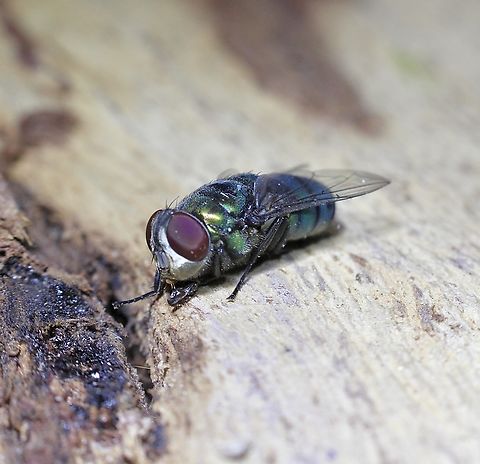
Appearance
This genus includes other species such as "Chrysomya putoria" and "Chrysomya bezziana", which are agents of myiasis. "C. rufifacies" prefers very warm weather and has a relatively short lifecycle. It is widely distributed geographically and prefers to colonize large carcasses over small ones. The species commonly has a greenish metallic appearance and is important medically, economically, and forensically.Distribution
"Chrysomya rufifacies" can be found in a wide variety of human habitats. The fly is native to Australia and has been recently expanding greatly in distribution. Its wide distribution is due to natural dispersal and transportation through airplanes, boats, or automobiles. It occupies an altitudinal range from sea level to 1,250 m, 1,400 m, or 2,100 m. The first appearance of the species in the continental United States occurred in the 1980s. The species is now established in Southern California, Arizona, Texas, Louisiana, and Florida. It is expected to eventually occupy most of the United States in the near future. Due to rapid dispersion of the species, it has become the dominant blow fly on human cadavers in north and central Florida, while "C. megacephala" continues to be dominant in southern Florida.Reproduction
The larvae of "C. rufifacies" are very easily identified with sharp, fleshy tubercles running down their bodies, and the mature larva is about 14 mm in length with a dirty yellowish color; hence the common name, hairy maggot blow fly. The of the posterior spiracle is very wide with a narrow gap that contains forked edges; the slits are short and wide, almost filling the plate.Uses
"Chrysomya rufifacies" has been used successfully in maggot therapy to treat patients with osteomyelitis, a microbial infection of the bone. "C. rufifacies" can be a vector for enteric pathogens in countries such as India and Australia, specifically, if it enters homes due to its attraction to feces, fruits, meats, and refuse. Multiple pathogens such as "Bacillus" bacteria, roundworms, and pinworms have been recovered from the alimentary canal and feces of "C. rufifacies". The late instars of the species are beneficial medically by acting as predators of maggots of pathogen-transmitting and myiasis-producing flies; thus, the larvae can be used as beneficial and effective biological control agents. However, certain strains from Australia, India, and Hawaii have been documented to have instars that are harmful when involved in secondary myiasis.References:
Some text fragments are auto parsed from Wikipedia.
