Appearance
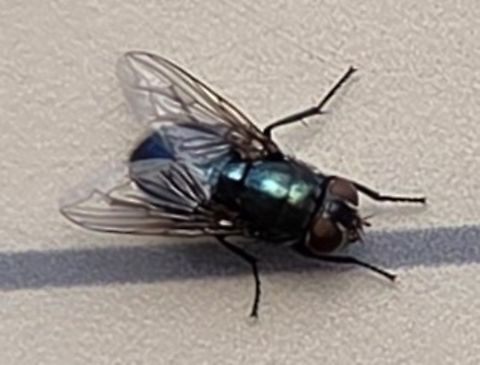
"Phormia regina" adults are metallic blue or green in color and have a distinctive set of orange setae near the anterior thoracic spiracle. They are also recognizable by their black gena, mostly white calypteres, and the distinctive bend in their wings.The black blow fly's wings are specialized with a sharp bend. These flies also have well-developed calypters. Blow flies generally are about the size of a house fly or a little larger, and many are metallic blue or green in color. Key characteristics of this species include black gena, mostly white calypters, and anterior thoracic spiracles that appear to be orange yellow due to being surrounded by bright orange setae.
Distribution
"P. regina" is commonly found across the entirety of the United States as well as across other regions in North AmericaHabitat
"P. regina" can be found on human corpses, animal carcasses, and feces. Researchers have observed these flies on a wide variety of animal excrement, but at least in the northwestern United States, they exhibit a preference for human, mink, and swine feces. "P. regina" is predominantly found in the northern United States during spring and summer months, but in the winter they are localized to more southern regions. This localization is tentatively linked to the importance of temperature on their development. These flies prefer rural areas, especially near water sources, as opposed to urban spaces—at least in the San Francisco Bay Area.Reproduction
Relatively few studies have been conducted on the adults of this species in comparison to those on larval development, mostly due to the importance of blow fly larvae in determining the "post mortem" interval of corpses during investigations by forensic entomologists. For this reason, many researchers have conducted experiments to investigate the effect of various environmental factors on the duration time of larval development in this species.Because the larval life cycle of this species is dependent on a climate with temperatures ranging from 12.7°C to 35 °C, it tends to inhabit the northern regions of the United States during summer months and southern regions in the winter. Researchers have discovered that at 40 to 45 °C, larval development occurs normally until the prepupal stage, at which point a majority of the larvae die. The few able to pupate at these high temperatures do not emerge as adults. The lowest temperature threshold for this species was found to be 12.5 °C below which females will not oviposit. The highest rate of development was seen at a constant temperature of 35 °C, where the average time of adult emergence was 265 hours. Flies at constant temperatures between 15 and 30 °C developed slower, with flies at the coolest temperatures taking the longest. Cyclic temperatures ranges of 25 to 35 °C and 15 to 25 °C proved to decrease the rate of development when compared to constant temperatures.. Each 10-degree fluctuation took place over a 12-hour span.)
Also, studies have been conducted to assess the effects of light exposure on developmental variability in larvae. Larvae exposed to cyclic photoperiods have higher rates of development than larvae exposed to constant photoperiods. These findings suggest that darkness may be a stimulus for larval growth. However, these variations in light photoperiods failed to influence pupal duration times.Adult females oviposit eggs on carrion. These eggs hatch into larvae that feed on the decaying tissue.Female black blow flies each have a pair of ovaries and lateral oviducts, one common oviduct, a vagina, and a bursa copulatrix, which is simply a sac-like cavity within the female that is roughly equivalent to a uterus. Each ovary has a lateral oviduct; these two lateral oviducts meet to form the common oviduct and connect the ovaries to the burs copulatrix. Three spermathecae are connected to the bursa copulatrix via spermathecal ducts, and two accessory glands attach to the bursa copulatrix near the spermathecae entries. The vagina is connected to the bursa copulatrix on the opposite end of the ovaries and allows the male aedeagus access to the bursa copulatrix and spermathecae.Male black blow flies have an external phallus that is a tube-like structure with unique flaps centrally located. The phallus can be divided up into several different sections. There is the hypophallus, which protrudes from the abdomen of the fly. The cornua, which is the name given to the centrally located wing-like flaps on the phallus, protrude from the hypophallus. A pair of paraphallic bulbs are embedded in the cornua with only their tips jutting out. These bulbs are sclerotized, meaning they are hardened, as are a variety of spines on the outside of the cornua. From the cornua a narrower tube structure, the acrophallus, extends with a terminal fluted opening, referred to as the gonophore, from which sperm and accessory secretions flood.
Food
Feeding habits vary greatly throughout the life cycle of "P. regina". The feeding habits of adult flies depend both on sex and reproduction status of the fly. This is particularly important with respect to their protein intake, which literature suggests has an important role in sexual maturation and copulation ability in adult "P. regina." Like most other flies, the black blow fly feeds via sponging. Though adults require various types of nutrients, in the wild they are typically able to procure all their nutrition from feces.Evolution
The life cycle and development of "Phormia regina" is similar to that of most other Dipteran species, in which females oviposit their eggs onto a nutrient substrate. Then, after hatching, the larvae feed throughout three instar stages until they have stored up enough calories to commence pupation and finally emerge as adult blow flies. Each transition from first, second, and third instar is marked by a molt, and eventually the third-instar larvae develop sclerotized casings which envelop and protect them throughout metamorphosis.Uses
"Phormia regina" is a flesh-eating fly not usually used for medical gain. However, the maggots from the black blow fly are used in maggot therapy, a type of biotherapy involving the intentional introduction of live, disinfected maggots into the skin and soft tissue wound of a human or animal for the purpose of selectively cleaning out only the necrotic tissue to promote healing.References:
Some text fragments are auto parsed from Wikipedia.
