Appearance
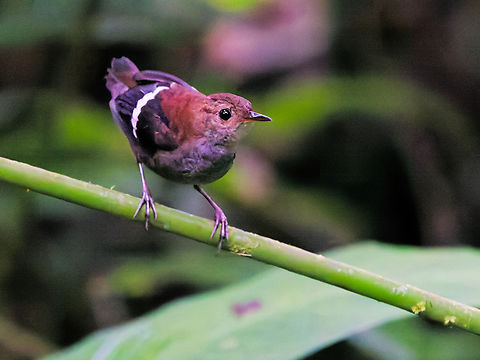
The wing-banded wren is 11.5 cm long and weighs 17 to 19 g. Adults of the nominate subspecies have a blackish-brown crown, upperparts, and tail. The upperparts have obscure dusky markings and the tail has obscure darker brown bars. Its dark chocolate-brown wing shows a broad white band when closed. It face is dark brown, the chin and throat gray, the chest gray-brown with dark tips on the feathers, and the belly and flanks a purer brown than the chest. The belly and flanks have faint bars. The juvenile's underparts appear scaly and it does not have the white wingbar. The upperparts of "M. b. caurensis" are a brighter rufous than the nominate's and it does not have the dusky markings on the back and breast. "M. b. bambla" is similar to "caurensis" but has a paler throat.Distribution
The subspecies of wing-banded wren are found thus:⤷ "M. b. albigularis", eastern Ecuador, northern and south-central Peru, and northwestern Brazil
⤷ "M. b. caurensis", extreme eastern Colombia and southern and southeastern Venezuela
⤷ "M. b. bambla", extreme eastern Venezuela, the Guianas, and northern Brazil
Status
The IUCN has assessed the wing-banded wren as being of Least Concern. Though it does not appear to be common anywhere, it "appears to be at relatively little risk at present, as large parts of its range are very sparsely populated by human beings."Habitat
The wing-banded wren inhabits lowland rainforest, both those with a dense understory and more open ones. It appears to require a wet understory with many rotting logs. In Venezuela it mostly ranges from sea level to 1,100 m but can be found as high as 1,500 m.Reproduction
Two wing-banded wren nests have been described. Both were found in late March in French Guiana and each held a well-grown nestling being fed by both parents. Both nests were about 2 m above ground in a cavity in an arboreal termite nest. The cavities were probably excavated by a yellow-billed jacamar.Food
The wing-banded wren forages on and very near the ground, preferring to explore rotten logs and other woody detritus. Unlike other members of its genus, it seems to only rarely forage in leaf litter. Its diet is mostly arthropods but it has also been seen carrying tiny frogs to a nest.References:
Some text fragments are auto parsed from Wikipedia.
