Appearance
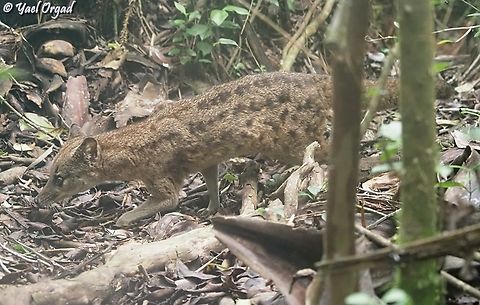
The Malagasy civet is a small mammal, about 47 centimetres long excluding the tail ). The males can weigh up to 1.9 kilograms, and the females can weigh up to 1.75 kilograms. It is the second largest carnivore in Madagascar after the fossa. it may be confused with the small Indian civet. It has a short coat greyish beige or brown in colour, with dark black horizontal stripes running from head to tail, where the stripes are vertical, wrapping around the bushier tail. The stripes morph into spots near the belly. Its legs are short and very thin.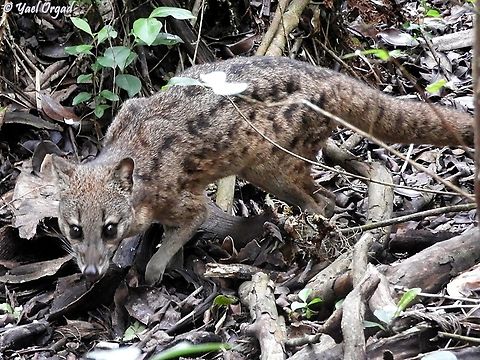
Naming
The Malagasy name "fanaloka" is related to the Malay word "pelanduk" "mousedeer" likely due to their similar sizes and silhouette.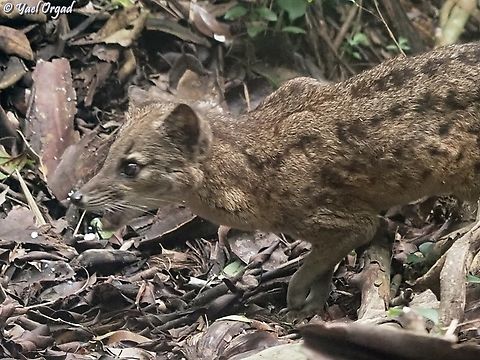
Distribution
The Malagasy civet is found in lowland and rainforest areas of Eastern and Northern areas of Madagascar, and can also be found in humid and isolated forests in Amber Mountain National Park, and farther north in the less-humid forests of Ankarana Reserve. It can be found from sea level to 1,600 metres above sea level, but is only common up to 1,000 metres above sea level.Status
The Malagasy civet is listed as Vulnerable by International Union for Conservation of Nature, with a decreasing population. Though threatened by deforestation, hunting, charcoal production, logging, and competition from introduced species such as dogs, cats, and small Indian civets, it is locally common. Introduced animals such as dogs are likely to prey on Malagasy civets. Its range is now reduced to isolated patches.Behavior
The Malagasy civet is nocturnal, though sources disagree over whether it is solitary or, unusual among euplerids, lives in pairs. It is not a good climber and frequents ravines. It eats small vertebrates, insects, aquatic animals, and eggs stolen from birds' nests. It is shy and secretive. Their vocalizations are similar to crying and groaning, as well as a sound similar to "coq-coq". Pairs of males and females defend a large area ) as their territory. In the winter, it may store fat in its tail, which can make up 25% of their weight. The mating season of the Malagasy civet is August to September and the gestation period is around three months, ending with the birth of one young. The young are rather well-developed, weigh around 65 to 70 grams, and are weaned in two to three months, leaving their parents at around one year old. The average lifespan of a Malagasy civet is about 21 years in captivity.Habitat
The Malagasy civet is found in lowland and rainforest areas of Eastern and Northern areas of Madagascar, and can also be found in humid and isolated forests in Amber Mountain National Park, and farther north in the less-humid forests of Ankarana Reserve. It can be found from sea level to 1,600 metres above sea level, but is only common up to 1,000 metres above sea level.References:
Some text fragments are auto parsed from Wikipedia.
