Appearance
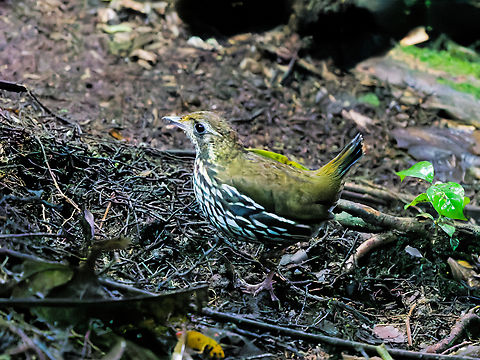
The short-tailed antthrush is 19 to 25 cm long and weighs 64 to 112 g. The sexes are alike. Adults of the nominate subspecies have a rufescent brown or brown crown with a black spot on their forecrown. They have white lores and a white streak behind their eye on an otherwise brown face. Their back, wings, and uppertail coverts are olive brown. Their tail is brown with a black band near the end and thin buff or whitish tips on the feathers. Their throat is white. Their underparts are mostly rich buff with wide black streaks on their breast and flanks and some black bars or spots on their crissum. Their iris is dark brown, their bill black with a paler base to the mandible, and their legs and feet brown or brownish gray.The other subspecies of the short-tailed antthrush share the nominate's basic pattern with some color variations. Their crowns can be blacker, their lores and postocular streak can be buffy, their upperparts can be less olive and more reddish brown, their underparts' base color can be whiter, and the amount of underpart streaking can be more or less.
Distribution
The short-tailed antthrush has a highly disjunct distribution. The subspecies are found thus:⤷ "C. c. columbiana": east slope of Colombia's Eastern Andes
⤷ "C. c. punctigula": from eastern Ecuador's Napo and Pastaza provinces south into northern Peru to the Marañon River
⤷ "C. c. olivacea": east-central Peru from the Department of Junín to the Department of Madre de Dios
⤷ "C. c. huachamacarii": Cerro Huachamacari and perhaps other tepuis in southern Venezuela
⤷ "C. c. berlepschi": from eastern Department of Cuzco in southern Peru east just into western Bolivia's La Paz Department
⤷ "C. c. venezuelana": Venezuelan Coastal Ranges
⤷ "C. c. yavii": Cerro Yavi and perhaps other tepuis in south-central Venezuela
⤷ "C. c. obscura": tepuis in southeastern Venezuela's Bolívar and southern Amazonas states and adjoining Brazilian tepuis
⤷ "C. c. fulvescens": Mt. Roraima in eastern Venezuela and tepuis in western Guyana and central Suriname
⤷ "C. c. boliviana": across central Bolivia from La Paz Department to Santa Cruz Department
⤷ "C. c. campanisona": eastern Brazil separately in Ceará, Alagoas, and from Bahia south to Rio Grande do Sul, eastern Paraguay, and northeastern Argentina
Status
The IUCN has assessed the short-tailed antthrush as being of Least Concern. It has a very large range; its population size is not known and is believed to be decreasing. No immediate threats have been identified. It is generally considered common but fairly common in Colombia and Venezuela and rare to uncommon in Peru. "[A]s is true of all species that are restricted to forest, it is vulnerable to habitat degradation or loss."Habitat
The short-tailed antthrush inhabits humid foothill and montane forests and woodlands throughout its several discrete ranges. In eastern Brazil it also occurs in lowland evergreen forest. In elevation it occurs between 500 and 1,800 m in Colombia, between 950 and 1,700 m in Ecuador, between 900 and 1,700 m in Peru, between 800 and 2,800 m in Bolivia, between 450 and 1,850 m in Venezuela, and between sea level and 1,000 m in most of Brazil and to 1,500 m on the tepuis.Reproduction
The short-tailed antthrush's breeding season appears to vary geographically but includes months between September and January. The few known nests were in cavities in live trees between 1 and 3 m above the ground. The usual clutch size is not known though one nest contained three eggs. The incubation period and details of parental care are unknown. The time from hatch to fledging is believed to be 16 to 19 days.Food
The short-tailed antthrush's diet and foraging behavior are not known, though it is assumed to eat mostly insects and other arthropods and perhaps also small vertebrates. It is almost entirely terrestrial. It walks slowly and deliberately, pumping its tail and meandering through thick vegetation and along roots and logs. It has been observed following army ants but generally forages apart from them.References:
Some text fragments are auto parsed from Wikipedia.
