Appearance
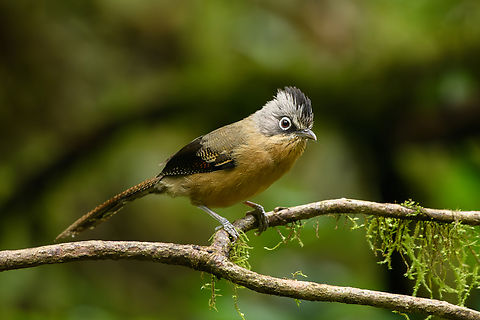
The black-crowned barwing is the only bird in the genus "Actinodura" to have a black crown. The transverse barring on the wings and the crest are characteristic of the genus. The sexes are similar in appearance. It has a grey head and nape, black crown and lore, white eye rings, dark brown irises, and dark beak with a flesh coloured tip. The throat is streaked with black-brown on a base of rufous-orange that matches the breast and belly area. The posterior parts of the body are olive-brown with indistinct dark bars. The wings have fine bars on the scapulars and black-brown with chestnut or orange-buff bars on most of the flight feathers. Their long tail is graduated chestnut with white tips and broad black bars.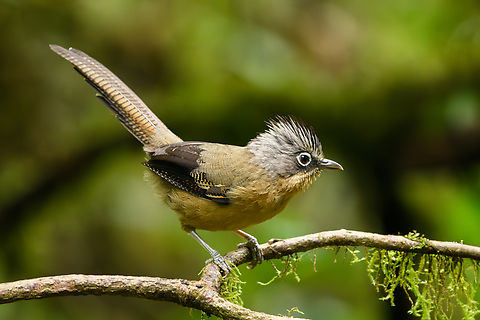
Distribution
They are resident at three locations in Laos and at seven locations in Vietnam. They are also found in Important Bird and Biodiversity Areas including the DakChung Plateau, Lo Xo Pass, and Ngoc Linh.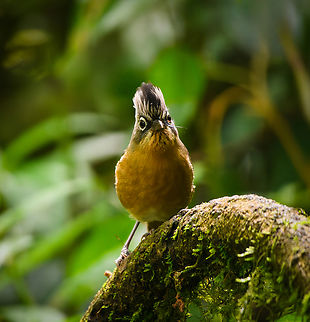
Status
It is threatened by habitat loss and is considered Near Threatened on the IUCN Red List.Behavior
Sightings have been either of single birds or in pairs.Habitat
Their natural habitats are subtropical or tropical moist montane forest, subtropical or tropical high-altitude shrubland, subtropical or tropical high-altitude grassland, and plantations. Although they use degraded/cleared forests, they are mostly found in secondary growth or evergreen forests.Their elevation maximum was at 2,400 m, with observers noting fewer sightings above 2,200 m. The minimum elevation range could not be determined properly since the site contained loss of forest habitat below 1,500 m, though there were sightings at 1,000 m.
Reproduction
Mates are first attracted through calling, then move to small branches in shrubs while perching close or against each other. The male displays by raising his crest and half-fanning his feathers while the female opens her wings less frequently and leans steeply over her perch. They preen each other briefly and rapidly with light pecking, while switching positions. Instances of copulating or almost copulating involved the birds swinging full circle around a branch where their tail-bases would briefly touch while moving downwards. This behaviour is not known in barwings, but is more common in babblers.Generation lengths are around 5.5 years.
Eggs and nest are undescribed.
Food
Their diet is not well known, but they are suspected to be insectivores that also eat vegetation. The bird is often seen foraging alone or with a partner around the smaller branches of tree canopy, trunk, and along larger moss-covered branches.References:
Some text fragments are auto parsed from Wikipedia.
