Appearance
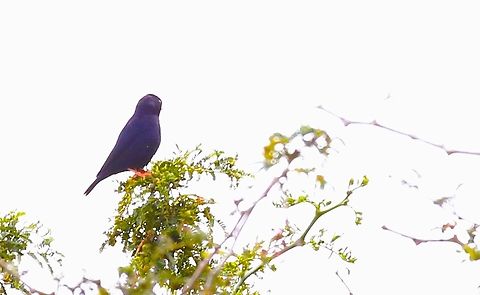
It is distinguishable from other indigobird species by bill and leg colours, the colour tinge of the male's breeding plumage, song, and to lesser extent, the nestling's plumage and mouth pattern. The bill colour can be red or white depending on the population, and there is some regional variation in the colour tone of the male's plumage.The village indigobird is 11–12 cm in length. The adult male is entirely greenish-black or bluish-black except for his orange-red legs and conical white bill. The female resembles a female house sparrow, with streaked brown upperparts, buff underparts, a whitish supercilium and a yellowish bill, although she also has red legs. Immature birds are like the female but plainer and without a supercilium.
Many of the indigobirds are very similar in appearance, with the males difficult to separate in the field, and the young and females near impossible. Helpful pointers with the village indigobird are the association with its host species, the red-billed firefinch, and its presence near human habitation.
Naming
There are six accepted subspecies:⤷ "V. c." subsp. "chalybeata" – West Africa: Senegambia to central Mali
─⟶ Description: Green, greenish-blue, or green-hued male plumage and white bills
⤷ "V. c." subsp. "neumanni" – Mali to South Sudan
⤷ "V. c." subsp. "ultramarina" – Ethiopia and Eritrea
⤷ "V. c." subsp. "centralis" – DRC, Uganda, Kenya and Tanzania
⤷ "V. c." subsp. "okavangoensis" Payne, 1973 – western Angola to northern Botswana
─⟶ Description: Red and white-billed birds with blue-hued male plumage
⤷ "V. c." subsp. "amauropteryx" – coastal East Africa and southeastern Africa
─⟶ Description: Red-billed birds with blue-hued male plumage
Distribution
It is a resident breeding bird in most of Africa south of the Sahara Desert.Behavior
The male village indigobird is territorial, and he has an elaborate courtship flight display. The song is given from a high perch, and consists of rapid sputtering and churring intermingled with mimicry of red-billed firefinch's song, especially the characteristic "chick-pea-pea-pea".The diet of this species consists of seeds and grain.
Habitat
This indigobird is found in many open habitats including open woodland, scrub and cultivation, but, as its name implies, it is most readily seen near villages.References:
Some text fragments are auto parsed from Wikipedia.
