Appearance
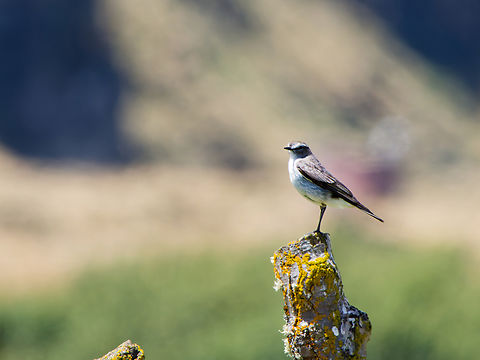
Taczanowski's ground tyrant is 16.5 to 19 cm long. The sexes have the same plumage. Adults have a brownish gray crown, dusky lores, a long white supercilium that extends past the eye, and a small white patch below the eye. Their nape and back are smoky gray. Their wings are a duskier smoky gray with some pale edges on the coverts. Their tail is blackish with thin white edges on the outermost feathers. Their throat is white, their breast gray, and their belly white with a buff tinge. They have a dark iris, a black bill, and black legs and feet.Distribution
Taczanowski's ground tyrant is found from Cajamarca Department in northern Peru south along the Andes into northwestern and central Bolivia's La Paz and Cochabamba departments. It inhabits puna and páramo grasslands and to a lesser degree dry areas with sparse vegetation. In elevation it ranges between 3,200 and 4,800 m in Peru but down to 2,700 m in Bolivia.Status
The IUCN has assessed Taczanowski's ground tyrant as being of Least Concern. Its population size is not known and is believed to be stable. No immediate threats have been identified. It is considered "fairly common and widespread" in Peru.Habitat
Taczanowski's ground tyrant is found from Cajamarca Department in northern Peru south along the Andes into northwestern and central Bolivia's La Paz and Cochabamba departments. It inhabits puna and páramo grasslands and to a lesser degree dry areas with sparse vegetation. In elevation it ranges between 3,200 and 4,800 m in Peru but down to 2,700 m in Bolivia.Reproduction
The breeding season of Taczanowski's ground tyrant includes December and January. Nothing else is known about the species' breeding biology.Food
Taczanowski's ground tyrant feeds on insects. It usually forages by itself in the breeding season; outside that it often is in small flocks that may include other species. It is almost wholly terrestrial; it will perch on rocks or a wall, though less often than some other ground tyrants. It runs and hops along the ground, stopping to stand erect before grabbing prey, or makes a short sally to the ground from a low perch.References:
Some text fragments are auto parsed from Wikipedia.
