Appearance
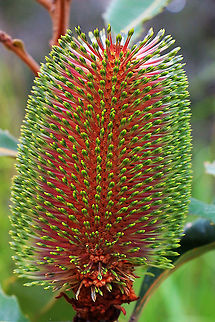
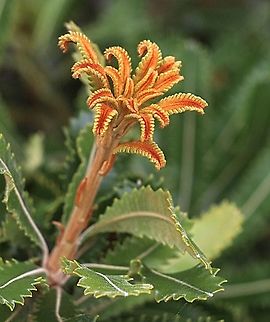
"Banksia robur" is a spreading shrub to 3 m, though larger single-stemmed specimens to 5 m high have been recorded in Wooroi State Forest near Caloundra. The grey-brown stems are 1–3 cm thick, with smooth bark. New branchlets are densely covered with rust-coloured fur that persists for 1–2 years; the upper tips of new growth have furry prophylls. Alternately arranged along the stem, the leaves are 12–30 cm in length and 5–7 cm in width, and oblong to obovate or elliptic in shape.Plants from different areas seem to flower at different times, some in spring and summer, others predominantly in autumn. The large flower spikes, up to 15 centimetres high and 5 to 6 centimetres wide, are metallic green with pinkish styles in bud, becoming cream-yellow and fading to golden-brown in the golden stage. The old flowers turn grey and persist on old cones, concealing the small follicles. These follicles are reddish and furred when new, before fading. The plant is lignotuberous, regenerating from the ground after fire.
Distribution
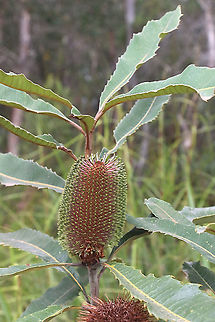
"Banksia robur" is native to coastal eastern Australia, where it is found from New South Wales to north Queensland. The Banksia Atlas recorded it as occurring along two stretches of coastline: from Wollongong to South West Rocks in New South Wales, then from Brunswick Heads in northern New South Wales to Shoalwater Bay in Queensland, and isolated populations near Bowen, Julatten and Cooktown in north Queensland.It is found in low-lying sandy or peaty soils that are often seasonally damp or periodically inundated. In the Sydney basin it is associated with heath flora such as pink swamp-heath, coral fern, and "Leptocarpus tenax".
Habitat
"Banksia robur" is native to coastal eastern Australia, where it is found from New South Wales to north Queensland. The Banksia Atlas recorded it as occurring along two stretches of coastline: from Wollongong to South West Rocks in New South Wales, then from Brunswick Heads in northern New South Wales to Shoalwater Bay in Queensland, and isolated populations near Bowen, Julatten and Cooktown in north Queensland.It is found in low-lying sandy or peaty soils that are often seasonally damp or periodically inundated. In the Sydney basin it is associated with heath flora such as pink swamp-heath, coral fern, and "Leptocarpus tenax"."Banksia robur" plants can live for more than 60 years. They respond to bushfire by resprouting from buds located on the large woody lignotuber.
Like other banksias, "B. robur" plays host to a wide variety of pollinators, including insects such as butterflies, moths, bees, wasps, ants and jewel beetles, and many bird species. These include honeyeaters such as New Holland honeyeater, little wattlebird, brown honeyeater, tawny-crowned honeyeater, Lewin's honeyeater, and little friarbird - all recorded in the 1988 "The Banksia Atlas" survey.
References:
Some text fragments are auto parsed from Wikipedia.
