Appearance
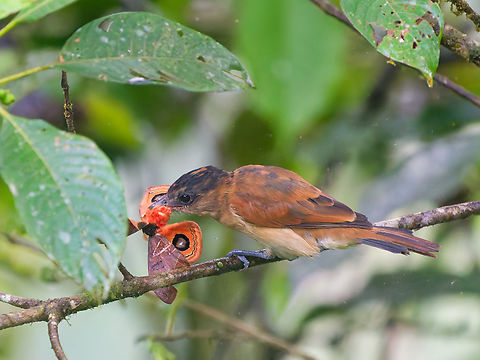
The one-colored becard is about 16.5 cm long and weighs about 35 g. The species is sexually dimorphic. Adult males of the nominate subspecies have a mostly dark slaty gray head and upperparts with a slightly darker crown and lighter rump. Their wings and tail are dark slaty gray with paler edges on the remiges. Their underparts are a somewhat paler gray their upperparts. They sometimes have a faint pinkish wash on the throat and a slight dusky tinge on the breast and upper belly. Adult females have a rufous-chestnut to rufous tawny crown, upperparts, and tail. Their wings have cinnamon-edged primaries and cinnamon-edged rufous secondaries and coverts. They have a whitish cinnamon spot above the lores on an otherwise buff-cinnamon face. Their underparts are mostly buffy cinnamon that is more whitish and cinnamon on the throat. Subspecies "P. h. quimarinus" is like the nominate. "P. h. canescens" has a slightly lighter throat and belly than the nominate.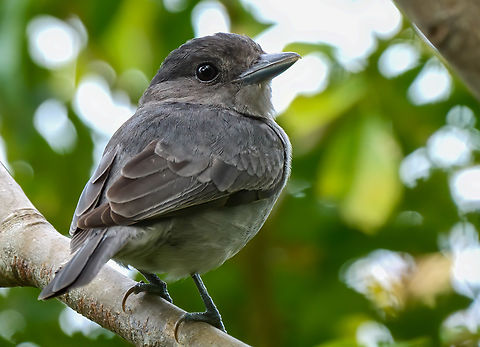
Distribution
The nominate subspecies of the one-colored becard has the largest range of the three. It is found in central and eastern Panama, on the Caribbean slope in the Canal area, on both slopes in eastern Panamá Province, and in the Pacific lowlands in Darién Province. Its range continues south on the Pacific slope of Colombia's Western Andes at least to southern Chocó Department. One source shows its range in the country continuing all the way to Ecuador. Its range further encompasses the entire length of western Ecuador and continues into northwestern Peru's Tumbes and Piura departments. Subspecies "P. h. quimarinus" is found in the northwestern Colombian departments of Antioquia, Bolívar, and Magdalena. "P. h. canescens" is found in Colombia to the northeast of "quimarinus" in Bolívar and Magdalena and in Venezuela on the eastern side of the Serranía del Perijá and the eastern and western sides of Lake Maracaibo.The one-colored becard inhabits a variety of forest types in the tropical zone. These include humid evergreen forest, dryer deciduous forest, gallery forest, and secondary forest. It also is found in clearings and arid scrublands that have tall trees. In elevation it overall is mostly found from sea level to 900 m. It reaches 1,000 m in Colombia, 1,500 m in Ecuador, 700 m in Peru, and 500 m in Venezuela.
Status
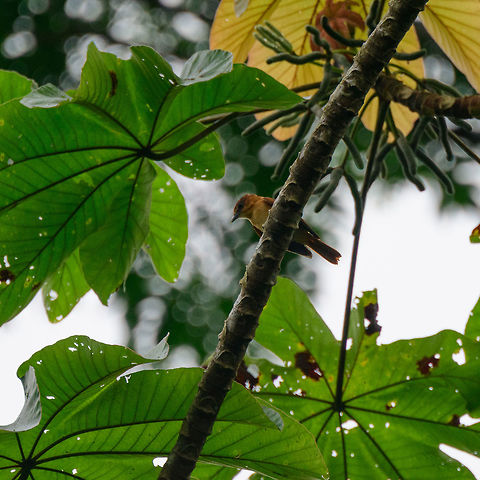
The IUCN has assessed the one-colored becard as being of Least Concern. It has a large range; its estimated population of at least 50,000 mature individuals is believed to be decreasing. No immediate threats have been identified. Overall it is considered to occur locally rather than continuously. It is "fairly common" in Colombia, "widespread and locally fairly common" in Ecuador, and "uncommon to locally fairly common" in Peru. It is known from only a few records in Venezuela. It occurs in several protected areas, most of them in Ecuador.Habitat
The nominate subspecies of the one-colored becard has the largest range of the three. It is found in central and eastern Panama, on the Caribbean slope in the Canal area, on both slopes in eastern Panamá Province, and in the Pacific lowlands in Darién Province. Its range continues south on the Pacific slope of Colombia's Western Andes at least to southern Chocó Department. One source shows its range in the country continuing all the way to Ecuador. Its range further encompasses the entire length of western Ecuador and continues into northwestern Peru's Tumbes and Piura departments. Subspecies "P. h. quimarinus" is found in the northwestern Colombian departments of Antioquia, Bolívar, and Magdalena. "P. h. canescens" is found in Colombia to the northeast of "quimarinus" in Bolívar and Magdalena and in Venezuela on the eastern side of the Serranía del Perijá and the eastern and western sides of Lake Maracaibo.The one-colored becard inhabits a variety of forest types in the tropical zone. These include humid evergreen forest, dryer deciduous forest, gallery forest, and secondary forest. It also is found in clearings and arid scrublands that have tall trees. In elevation it overall is mostly found from sea level to 900 m. It reaches 1,000 m in Colombia, 1,500 m in Ecuador, 700 m in Peru, and 500 m in Venezuela.
Reproduction
The only information on the one-colored becard's breeding biology comes from a 2010 publication. Nests were found in southwestern Ecuador in February and March. They were irregular balls with a side entrance hanging from a tree branch between about 4 and 14 m above the ground. They were made from dry grass and weeds lined with feathers and soft plant material. The clutches were of three and four eggs. The incubation period is not known but the time to fledging was estimated at 24 to 29 days after hatch.{| cellpadding="2" cellspacing="0" style="background-color:var; color:var;"
|- style="vertical-align:middle;"
| style="line-height:50px;vertical-align:middle;text-align:center;" |
| style="vertical-align:middle;line-height:2;" |
Songs and calls
|}
Food
The one-colored becard feeds on insects and fruit. It usually forages in pairs though sometimes singly and joins mixed-species feeding flocks about as often as it remains apart from them. It forages from the forest's mid-story to its subcanopy, usually at the forest edges.References:
Some text fragments are auto parsed from Wikipedia.

