JungleDragon is a nature and wildlife community for photographers, travellers and anyone who loves nature. We're genuine, free, ad-free and beautiful.

Join

Sea Spider - Pantopoda Info from Wikipedia :<br />
<br />
Sea spiders, also called Pantopoda or pycnogonids, (&#039;pycno-&#039; closely packed, &#039;gonid&#039; gonidia) are marine arthropods of class Pycnogonida. They are cosmopolitan, found especially in the Mediterranean and Caribbean Seas, as well as the Arctic and Antarctic Oceans. There are over 1300 known species, ranging in size from 1 millimetre (0.039 in) to over 90 cm (35 in) in some deep water species. Most are toward the smaller end of this range in relatively shallow depths; however, they can grow to be quite large in Antarctic waters.<br />
<br />
Although &quot;sea spiders&quot; are not true spiders, or even arachnids, their traditional classification as chelicerates would place them closer to true spiders than to other well-known arthropod groups, such as insects or crustaceans. Even this is in dispute, however, as genetic evidence suggests they may even be an ancient sister group to all other living arthropods.<br />
<br />
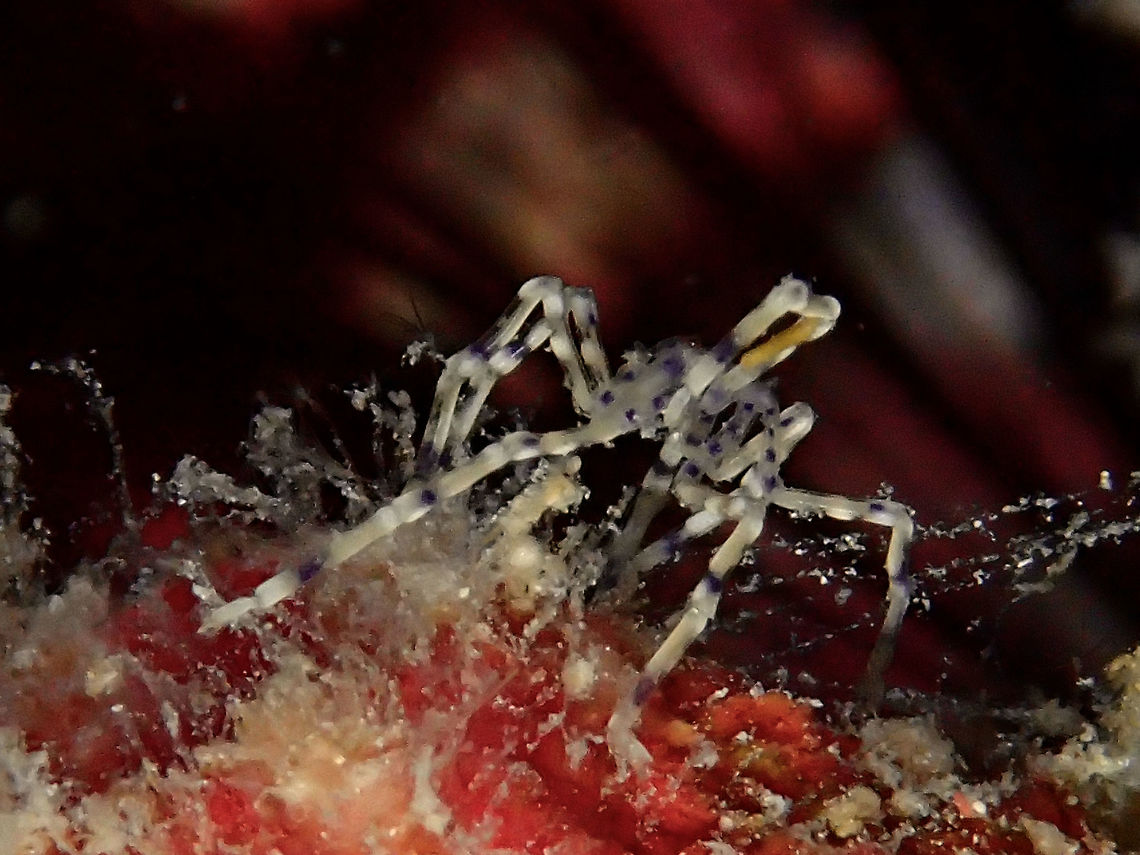
The Sea Spider in this particular picture is around 1 cm in size, probably common as I have seen them several times, both in Malaysia and Philippines.  It is creamy/yellowish in colour with spots of purple. Fall,Geotagged,Malaysia,Pantopoda,Sabah,Sea Spider Click/tap to enlarge

Sea Spider - Pantopoda

Info from Wikipedia :

Sea spiders, also called Pantopoda or pycnogonids, ('pycno-' closely packed, 'gonid' gonidia) are marine arthropods of class Pycnogonida. They are cosmopolitan, found especially in the Mediterranean and Caribbean Seas, as well as the Arctic and Antarctic Oceans. There are over 1300 known species, ranging in size from 1 millimetre (0.039 in) to over 90 cm (35 in) in some deep water species. Most are toward the smaller end of this range in relatively shallow depths; however, they can grow to be quite large in Antarctic waters.

Although "sea spiders" are not true spiders, or even arachnids, their traditional classification as chelicerates would place them closer to true spiders than to other well-known arthropod groups, such as insects or crustaceans. Even this is in dispute, however, as genetic evidence suggests they may even be an ancient sister group to all other living arthropods.

The Sea Spider in this particular picture is around 1 cm in size, probably common as I have seen them several times, both in Malaysia and Philippines. It is creamy/yellowish in colour with spots of purple.

Sign in or Join in order to comment.

No species identified

The species on this photo is not identified yet. When signed in, you can identify species on photos that you uploaded. If you have earned the social image editing capability, you can also identify species on photos uploaded by others.

View Albert Kang's profile

By Albert Kang

All rights reserved
Uploaded Nov 28, 2016. Captured Nov 18, 2016 08:26 in Unnamed Road, 91308 Semporna, Sabah, Malaysia.
  • TG-4
  • f/6.3
  • 1/200s
  • ISO640
  • 18mm