No species identified
The species on this photo is not identified yet. When signed in, you can identify species on photos that you uploaded. If you have earned the social image editing capability, you can also identify species on photos uploaded by others.

By Claire Hamilton
All rights reserved
Uploaded Dec 11, 2014. Captured Dec 11, 2014 10:49 in Unnamed Road, South Africa.

comments (3)
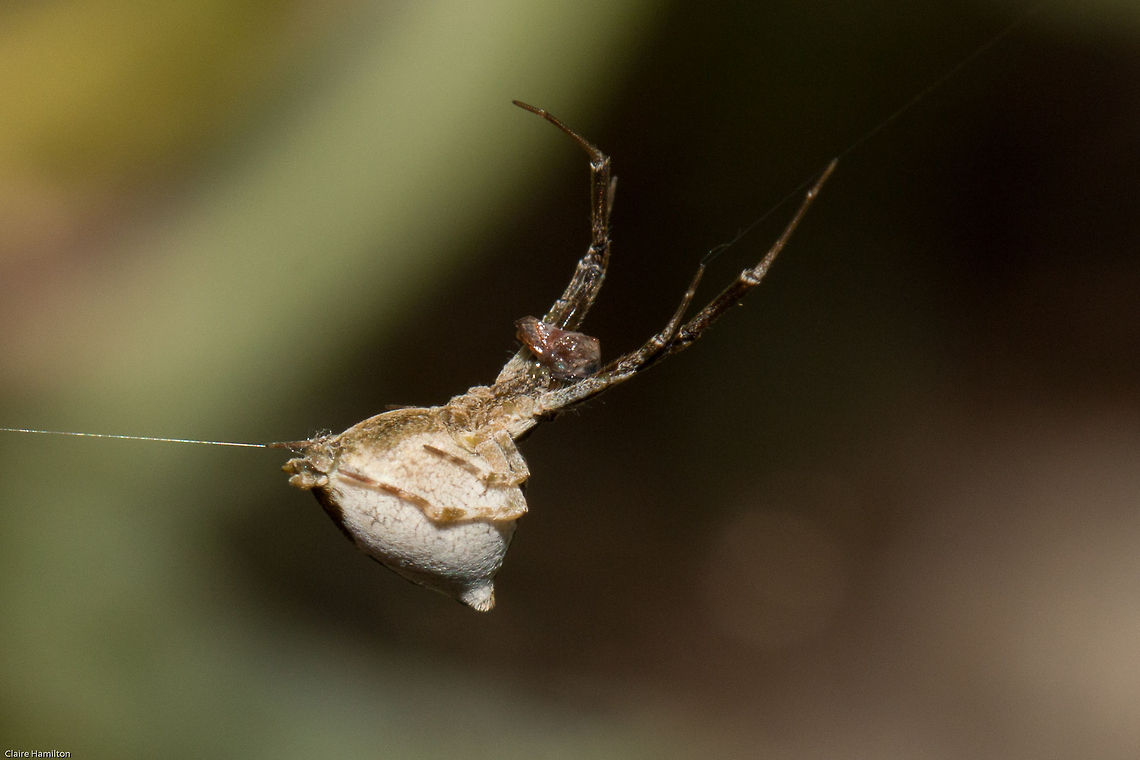
Uloborid spiders are unusual in having no poison glands. They rely completely on wrapping their prey in silk. The spider belongs to the cribellate spider group because they comb the silk to fluffy wool.
The web they construct is an incomplete wheel web and looks a little clumsy and asymmetrical. The web is usually built horizontal. Some species use a single line to catch prey.
Special features of the web are the hub, which is closely and beautifully meshed, and the ribboned decorations or stabilmenta that ornament the orb and possibly add to its strength.
Different variations are observed, V-shaped, four ribbons forming a cross, broken or complete circles around the hub.
In position the spider lies stretched out beneath the hub of her web, her legs directed forward and backward forming a bridge between the stabilmenta and make a complete band across the snare. As she hangs there, she often resembles a stick or a leaf.
When the eggs are laid the elongate sacs are laid in a row across the web and then aligns her long body so that she becomes almost indistinguishable from them.
The Uloboridae can be found in large social groups together in hollow trees, under houses or beneath rock ledges. Their snares may be tangles together with the webs of the other spiders.
The spiders rarely exceed a body length of 12 mm and are distinguished by their very long, often curved, forelegs. Posted 11 years ago