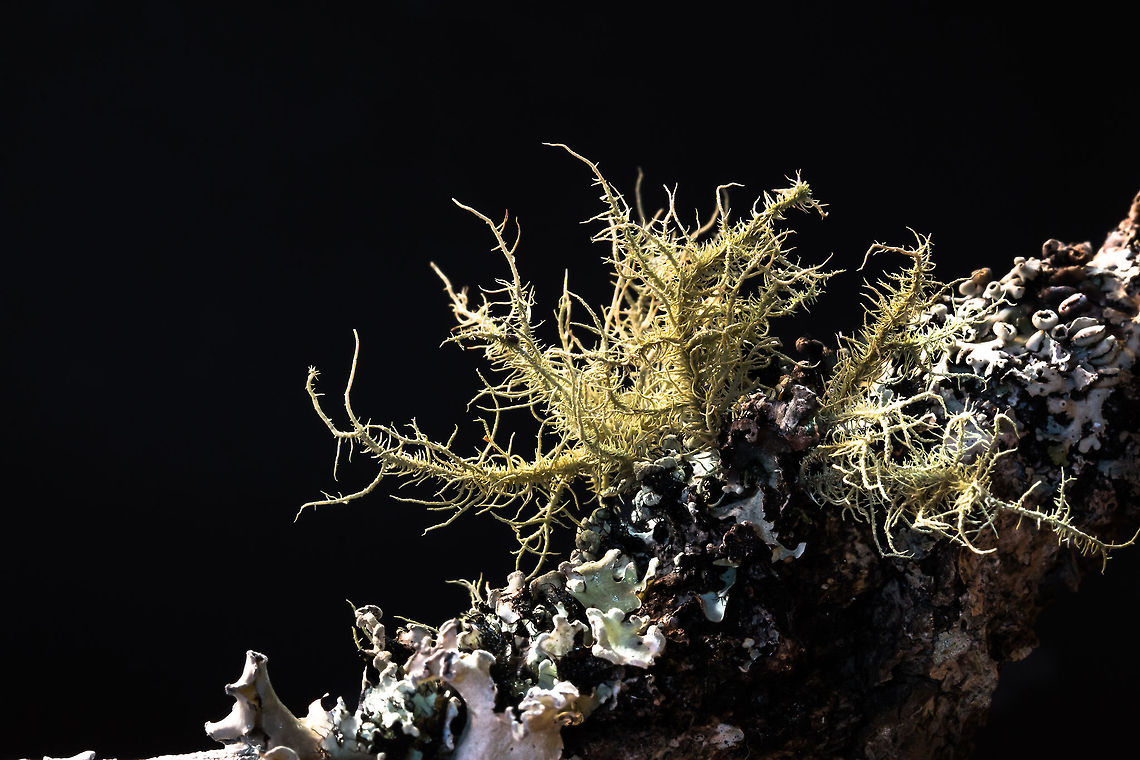
Old Man's Beard
A type of lichen (Usnea sp.) that is typical growing from trees in damp or humid forests, it tends to form on sick or dying trees which often leads people to think that it is the lichen itself killing its host, but that is not the case. Strangely enough, it is a form of fungi. I think this one is U. barbata but not 100% sure.
The forest around me is covered in this, which tends to form long tendrils hence its name. This is just a baby one.
No species identified
The species on this photo is not identified yet. When signed in, you can identify species on photos that you uploaded. If you have earned the social image editing capability, you can also identify species on photos uploaded by others.

By Claire Hamilton
All rights reserved
Uploaded Jun 4, 2014. Captured Jun 2, 2014 16:15 in Unnamed Road, South Africa.

comments (2)
A lichen consists of 2 or more partners that live together symbiotically, with both of them benefiting from the alliance. One partner is a fungus. The other is either an alga (usually a green alga) or a cyanobacterium, which is sometimes called a blue-green alga although it is more closely related to bacteria than algae.
There are around 30,000 species worldwide and cover 8% of the earths surface including some of the most extreme environments.
Lichens are incredibly useful because they tell us about the health of our environment. Lichens are very sensitive to air pollution. As a rule of thumb, the smaller the variety of lichens in an area, the more polluted it is.
(Taken from the Natural History Museum (UK) website) Posted 11 years ago