JungleDragon is a nature and wildlife community for photographers, travellers and anyone who loves nature. We're genuine, free, ad-free and beautiful.

Join

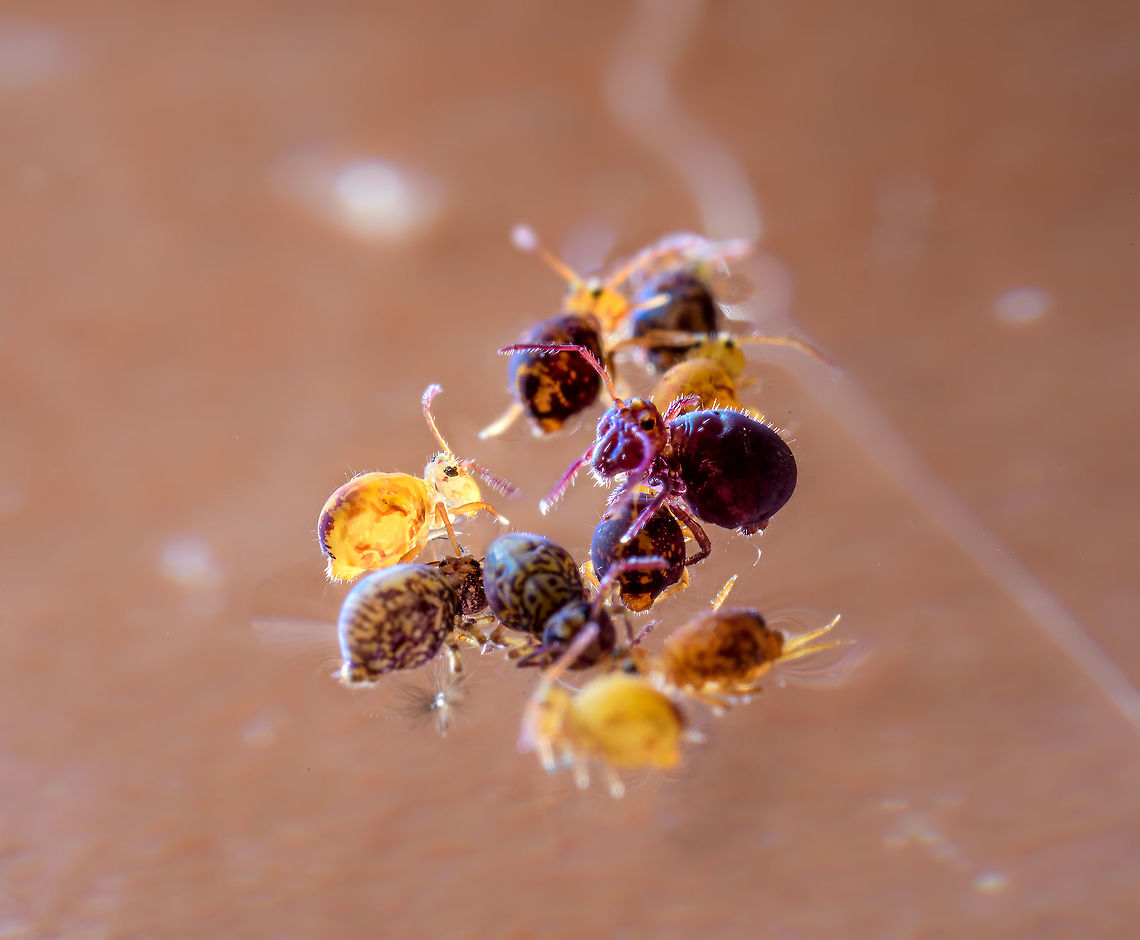
Dicyrtoma fusca + Dicyrtomina ornata From this side view, you can see how much larger Dicyrtoma fusca is compared to the others. It&#039;s the &quot;big&quot; dark red springtail crawling over a much smaller one. Opposite and in focus (bright yellow) is a young Dicyrtomina ornata. Look closely and you can see its &quot;spring  tail&quot; folded under its body.<br />
<br />
Here&#039;s an index photo for the entire group:<br />
<figure class="photo"><a href="https://www.jungledragon.com/image/104993/dicyrtoma_fusca_dicyrtoma_dorsosignata_dicyrtomina_ornata.html" title="Dicyrtoma fusca + Dicyrtoma dorsosignata + Dicyrtomina ornata"><img src="https://s3.amazonaws.com/media.jungledragon.com/images/2/104993_thumb.jpg?AWSAccessKeyId=05GMT0V3GWVNE7GGM1R2&Expires=1770854410&Signature=Cid032mlZ8pF4f8R5armivfEjSo%3D" width="200" height="192" alt="Dicyrtoma fusca + Dicyrtoma dorsosignata + Dicyrtomina ornata Here&#039;s the value pack, bulk discount shot of last weekend&#039;s springtail session. It shows all 10 individuals collected in a petri dish in a single 5:1 shot, cropped. I didn&#039;t even position them, they drifted to the middle on their own. I did take some 50 shots to get them aligned and somewhat in focus. Kind of like a group shot of people, always somebody blinking.<br />
<br />
Let&#039;s discuss species, with credit to Frans Jansen for the help (http://collembola.org/). <br />
<br />
In the bottom right corner, the dark red/purple individual is Dicyrtoma fusca. It is significantly larger than the others. Here it is isolated:<br />
<br />
https://www.jungledragon.com/image/104971/dicyrtoma_fusca_lateral_netherlands.html<br />
https://www.jungledragon.com/image/104974/dicyrtoma_fusca_frontal_netherlands.html<br />
At 9 o&#039; clock, you see a pair of muddy green/yellow individuals with a distinctive pattern. This is Dicyrtoma dorsosignata, which as of yesterday is confirmed to be the first known report of the species in the Netherlands:<br />
<br />
https://www.jungledragon.com/image/104964/dicyrtoma_dorsosignata_heesch_netherlands.html<br />
All 7 remaining individuals are the commonly found Dicyrtomina ornata, at different stages in their life cycle. Simplified: the larger the older, the darker the older. <br />
<br />
Another interesting thing I learned from Frans is the taxonomy history, and how this affects naming. As you can see from my photo, a singular species can have a wildly different appearance based on its life stage. Early taxonomists sometimes categorized them (incorrectly) as a separate species. For example, this one...<br />
<br />
https://www.jungledragon.com/image/104612/dicyrtomina_ornata_heesch_netherlands.html<br />
...was once considered to be the species Forma couloni. Then, taxonomists realized it really is a particular variant of Dicyrtomina ornata instead. To fix this mistake, they use the old (incorrect) species name and reuse that name to name the variant. The above photo therefore shows a Dicyrtomina ornata forma couloni. Which you can read as &quot;variant of Dicyrtomina ornata, once considered as species forma couloni&quot;.<br />
<br />
Collembola usually have 5 juvenile instars, and several adult instars, with females having more instars than males.<br />
<br />
As said, credit to Frans for this info. Europe,Extreme Macro,Netherlands,Springtail,World" /></a></figure> Europe,Extreme Macro,Netherlands,Springtail,World Click/tap to enlarge

Dicyrtoma fusca + Dicyrtomina ornata

From this side view, you can see how much larger Dicyrtoma fusca is compared to the others. It's the "big" dark red springtail crawling over a much smaller one. Opposite and in focus (bright yellow) is a young Dicyrtomina ornata. Look closely and you can see its "spring tail" folded under its body.

Here's an index photo for the entire group:
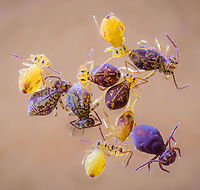
Dicyrtoma fusca + Dicyrtoma dorsosignata + Dicyrtomina ornata Here's the value pack, bulk discount shot of last weekend's springtail session. It shows all 10 individuals collected in a petri dish in a single 5:1 shot, cropped. I didn't even position them, they drifted to the middle on their own. I did take some 50 shots to get them aligned and somewhat in focus. Kind of like a group shot of people, always somebody blinking.<br />
<br />
Let's discuss species, with credit to Frans Jansen for the help (http://collembola.org/). <br />
<br />
In the bottom right corner, the dark red/purple individual is Dicyrtoma fusca. It is significantly larger than the others. Here it is isolated:<br />
<br />
https://www.jungledragon.com/image/104971/dicyrtoma_fusca_lateral_netherlands.html<br />
https://www.jungledragon.com/image/104974/dicyrtoma_fusca_frontal_netherlands.html<br />
At 9 o' clock, you see a pair of muddy green/yellow individuals with a distinctive pattern. This is Dicyrtoma dorsosignata, which as of yesterday is confirmed to be the first known report of the species in the Netherlands:<br />
<br />
https://www.jungledragon.com/image/104964/dicyrtoma_dorsosignata_heesch_netherlands.html<br />
All 7 remaining individuals are the commonly found Dicyrtomina ornata, at different stages in their life cycle. Simplified: the larger the older, the darker the older. <br />
<br />
Another interesting thing I learned from Frans is the taxonomy history, and how this affects naming. As you can see from my photo, a singular species can have a wildly different appearance based on its life stage. Early taxonomists sometimes categorized them (incorrectly) as a separate species. For example, this one...<br />
<br />
https://www.jungledragon.com/image/104612/dicyrtomina_ornata_heesch_netherlands.html<br />
...was once considered to be the species Forma couloni. Then, taxonomists realized it really is a particular variant of Dicyrtomina ornata instead. To fix this mistake, they use the old (incorrect) species name and reuse that name to name the variant. The above photo therefore shows a Dicyrtomina ornata forma couloni. Which you can read as "variant of Dicyrtomina ornata, once considered as species forma couloni".<br />
<br />
Collembola usually have 5 juvenile instars, and several adult instars, with females having more instars than males.<br />
<br />
As said, credit to Frans for this info. Europe,Extreme Macro,Netherlands,Springtail,World

Sign in or Join in order to comment.

No species identified

The species on this photo is not identified yet. When signed in, you can identify species on photos that you uploaded. If you have earned the social image editing capability, you can also identify species on photos uploaded by others.

View Ferdy Christant's profile

By Ferdy Christant

All rights reserved
Uploaded Dec 2, 2020. Captured Nov 27, 2020 14:37.
  • NIKON D850
  • f/1.2
  • 1/320s
  • ISO64
  • 50mm