Appearance
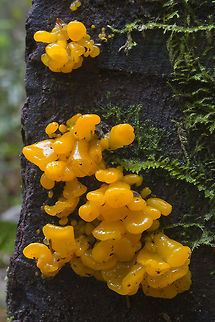
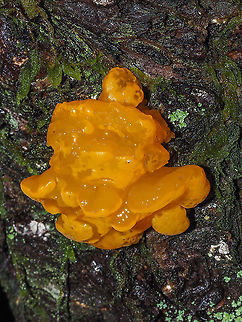
The species is saprotrophic and grows on dead coniferous wood. The basidiocarps are gelatinous, bright orange, and extremely variable in shape, but typically stoutly stipitate with a spoon- or cup-shaped, spore-bearing head. They are frequently erumpent in groups, often coalescing to form complex masses up to 6 cm across. Microscopically it is distinguished from most other species of ''Dacrymyces'' by its comparatively large , 7-septate basidiospores.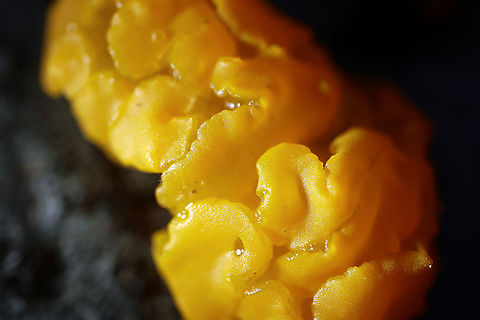
Naming
''Tremella mesenterica'' and ''Naematelia aurantia'' are macroscopically identical to ''D. chrysospermus'' but can easily be separated by their growth on hardwood as well as their microscopic characteristics. While looking so similar, they belong to a different class of fungi, Tremellomycetes.''Dacryopinax spathularia'' and species of ''Femsjonia'' can also be similar.
Distribution
''Dacrymyces chrysospermus'' was originally described from New England, but is said to have a worldwide distribution.References:
Some text fragments are auto parsed from Wikipedia.


