Appearance
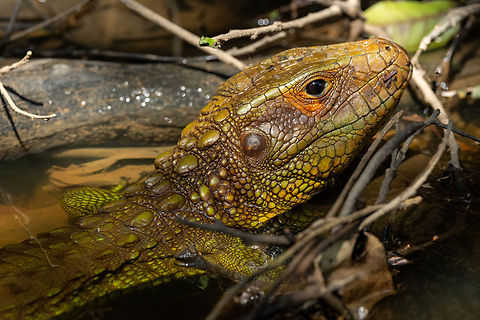
The northern caiman lizard is built similarly to its cousin the tegu, with a large heavy set body and short but powerful limbs. Its head is bulky and often a red or orange color. Their jaws are heavily muscular to help aid in eating its normal prey of snails, crawfish and fresh water clams. It also has a few adaptations that help it in its watery habitat. It has a long and flattened tail, similar to its namesake, the caiman. The long tail helps the northern caiman lizard to successfully swim and dive. A clear third eyelid is thought to act like a pair of goggles underwater.The body of the northern caiman lizard is very similar to that of a crocodile. It is typically a bright green with slight dark green banding. There are horned raised scales along the dorsal of the back. This helps to provide some protection against predators.
These lizards can reach up to 4 ft long and weigh up to 10 lb.
Distribution
"D. guianensis" can be found in the south American countries of Brazil, Colombia, Ecuador, Peru, and the Guianas. It lives in swampy habitats and other wooded areas which are flooded. It is mostly aquatic and is an excellent climber. It spends most of its time basking on branches overhanging waterways such that it may be able to flee from predation by disappearing underwater.The lizard's wild population number is unknown. There has yet to be a study on them in their natural habitat. Much of what we know about them comes from captive animals in zoos and aquariums, as well as in the homes of hobbyists.
This species was heavily hunted for their hides. In 1970 they were provided protection and the export of their skin dropped. Now local populations are safe where their habitat is protected. Captive farms have since been set up to provide animals for the leather trade. In recent years a number of these animals have found themselves in the pet trade.
Habitat
"D. guianensis" can be found in the south American countries of Brazil, Colombia, Ecuador, Peru, and the Guianas. It lives in swampy habitats and other wooded areas which are flooded. It is mostly aquatic and is an excellent climber. It spends most of its time basking on branches overhanging waterways such that it may be able to flee from predation by disappearing underwater.The lizard's wild population number is unknown. There has yet to be a study on them in their natural habitat. Much of what we know about them comes from captive animals in zoos and aquariums, as well as in the homes of hobbyists.
This species was heavily hunted for their hides. In 1970 they were provided protection and the export of their skin dropped. Now local populations are safe where their habitat is protected. Captive farms have since been set up to provide animals for the leather trade. In recent years a number of these animals have found themselves in the pet trade.
References:
Some text fragments are auto parsed from Wikipedia.
