Appearance
"Curculigo capitulata" is a tuberous evergreen herb with thick rhizomes and thin stolons. In adverse conditions, the rhizomes may remain dormant for a long time.The leaves are palm-like, which is why the plant is more known as palm grass. Usually, 4-7 leaves are held on 30–80 cm long stalks. Leaf blades are oblong-lanceolate shaped to sublong with pointed tips and with a surface pleated lengthwise. The leaves are usually 40–90 cm × 5–14 cm. The inflorescences are buried amid the leaf bases and concealed by the leaves.
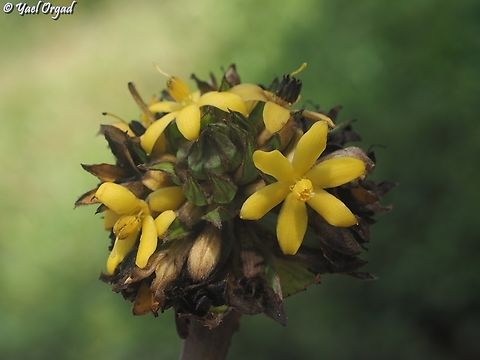
Flowering stems are 15–30 cm long with brown hair. Flower-racemes are around 2.5–5 cm, densely flowered with headlike to subovoid shape. The flower bracts are lanceolate, and around 1.5-2.5 cm in length. The bracts are usually brown, green in colour and are covered by hair. The flowers span approx. 23 to 25 mm petal-tip to petal-tip.
Flowering stalks are around 7 mm long, carrying yellow flowers with blunt tips with hairy outer petals. In some places such as Bangladesh, each plant grows one flower most of the time and sometimes in groups of 2-3 flowers. But in some places, such as Nepal, each stem can carry a lot of flowers. Each flower usually has 6 petals that are oblong ovate in shapes and about 8 mm × 3.5–4 mm in length. The flowers are ginger-like and sweetly scented.
There are three sepals and three yellow petals. The stamens are interesting as they originate separately and then come together/seem to combine to form a staminal tube around the stigma/style.
Stamens are 5–6 mm with filaments less than 1mm and linear anther about 5mm. The ovary is hairy with style longer than stamens. The stigma is almost petaloid in shape and is subcapitate.
The berries of "Curculigo capitulata" are white, round with 4-5mm diameter. The fruit are sweet when ripe. The seeds are black and are irregularly shaped. However, fruits are rarely seen in cultivated plants.
Naming
The species can be used for massed borders as soil cover at the base of large trees as it can accommodate shaded conditions. Little maintenance is required, and the plant tolerates a range of temperatures.Distribution
"Curculigo capitulata" is native to South Asia, in countries such as India, Indonesia, Sri Lanka, Bangladesh and Nepal through Southeast to Southern China, Taiwan, East Himalayas and northern Australia. It can also be found in tropical Africa. However, the plant has spread far across the tropics and can be found naturalized and in cultivation."C. capitulata" was purposefully introduced as an ornamental plant and is widely grown in gardens. It is popular as a garden plant in lowlands and midlands of Sri Lanka. Although it is not abundant, but "M. capitulata" can also be found in older gardens in Hawaii.
Habitat
"Curculigo capitulata" is usually found in forests, in shady places with moisture. Naturalized species can also be found along the stream banks and other wet habitat. It is usually found in places 800–2200 meters above sea level, but sometimes it can also be found as low as 300m. It can be found at elevations of 1000-1500m in Colombia."Curculigo capitulata" propagates by seeds and prefers temperature between 16 °C to 24 °C. The growth stops when the temperature is below 10 °C, but it can survive in very low temperature such as 0 °C for a short period of time before losing its aerial portion. Leaves will regrow in the spring.
The plant requires well drained, damp soils rich in organic matter, slightly acidic in pH.
Reproduction
There is little information on the reproductive methods of the plant, but it is thought to reproduce by seeds and rhizomes.Though rare, reproduction by seeds of the species occurs in draining organic loam with a humid environment and temperature around 24 to 26 degrees Celsius. The seeds of "Curculigo captulata" have short viability, meaning that planting should be undertaken as soon as they are ripe.
Vegetative propagation occurs by division of rhizomes in mature clumps.
Uses
The "Curculigo" genus belongs to the family Hypoxidaceae. This family are traditionally used to treat diseases such as diabetes, blood loss and viral infections."Curculigo capitulata" is mainly cultivated as an ornamental plant in modern society. The species was used to wrap fruits, vegetables and other food during transportation in Indonesia.The papery texture of the leaves indicates the plant is rich in fibre. The fibres are ustilised in many ways by Southeast Asians. For example, the fibers collected from the leaves can be used to make fishing nets and ropes. The Luha people from northern Thailand use fibres collected from the leaves as wrappings. Additionally, the hill people of Camarine in Luzon, Philippines also make false hair using these fibres. In this culture, the fibre can also be used as a warp in toy looms for children.
The fruits of the species are edible, so they can be incorporated into everyday diet.
The leaves of the species can also be made into a leaf bandage to cover wounds."Curculigo capitulata" has a long history of medical use in Southeast Asia. It is widely used in traditional Chinese and Indian medicine to treat severe chronic disease, rheumatic arthritis, nephritis, urinary tract infection, colic, asthma, jaundice, spermatorrhoea, consumptive cough, impotence, kidney asemia, hemorrhoids, diarrhea, and gonorrhea. It is also used in traditional Dai medicine to treat urinary tract infection, acute renal pelvis and phrenitis, nephritis-edema, cystitis, nephrolithiasis, hypertension and rheumatic arthritis. It can also be used in veterinary medicine and for land conservation. The rhizomes are used in traditional medicine for eye infection and gastric disorders.The species has high antioxidant, cytotoxic, thrombolytic, anti-inflammatory and analgesic activities, indicating that the species has the potential to be used as treatment of several chronic diseases. "Curculigo capitulata" has a strong reduction capacity ", indicating strong antioxidant activity and reduction ability. The extract from the plant also displays inhibition of protein denaturation, indicating ability to prevent blood clotting.
The plant is also found to have high content in phenols and flavonoids. Phenol is often used in skin care for its antimicrobial, anti-inflammatory and antiaging activities. This high concentration of phenol may indicate a potential use of "M. capitulata" extract in skin care. Flavonoids are often found in fruits, grains, and vegetables. It has anti-oxidation activity as it fights the free radicals in the body and helps the body relax.
A recent experiment also shows the roots of the species have antifungal activatity against "Fusarium oxysportium" f. sp. Cubense tropical race 4. This pathogen is the main cause of fusarium wilt in banana, meaning that extracts from "Curculigo capitulata" has the potential to treat infectious diseases in banana.
Furthermore, the essential oil extracted from the fruit of "Curculigo capitulata" are also found to have antibacterial and antifungal activities. This means more applications of the plant can be found with further studies.The species can be used for massed borders as soil cover at the base of large trees as it can accommodate shaded conditions. Little maintenance is required, and the plant tolerates a range of temperatures.
References:
Some text fragments are auto parsed from Wikipedia.
