Appearance
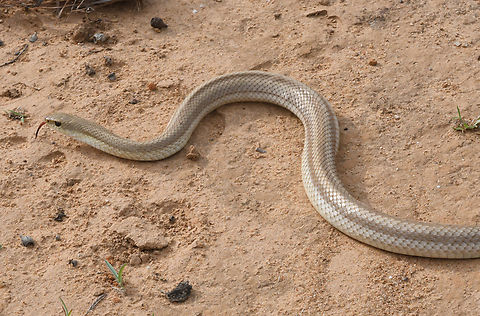
"Leioheterodon modestus" is a smooth-scaled snake with a slightly pointed, projecting snout. Their eyes are large with round pupils. Hatchlings average between 6–12 in, and adults average around 3–5 ft in length. They are named after the Latin word "modestus", meaning "modest", for their plain, pale yellow-brown coloration. The mineralized skeleton of this species of snake contains apatite. The three species within the genus "Leioheterodon" are morphologically similar, and "Leioheterodon spp." have been known to do elaborate defensive displays when threatened by predators; a common behavior in many hognose species. These defensive displays include hissing, flattening of the neck, feign striking and death feigning.Kelley, L. G.. The Embeddedness of Hognose Snakes in the Wildlife Pet Trade and the Relevance of Assemblage Geographies for Reptile Conservation. Retrieved from http://purl.flvc.org/fsu/fd/FSU_migr_etd-4942 Adults display sexual dimorphism between males and females, however this is very subtle with males just being slightly larger. This is because adult males perform male-male combat, where two males try to pin each other down in a ritualistic behavior for dominance of an area or for mating rights with a female.Distribution
They are endemic to Madagascar. Multiple accounts describe this species being found in elevations between 40–300 m. However, one account describes two individuals 200 km east of their known range, as well as at an elevation of 1,280 m and 1,460 m, respectively, extending the range of the species. They have been documented using rock caverns and limestone massifs, and also on multiple occasions occupying ant hills. This species is not well distributed throughout Madagascar and there is a lot of habitat fragmentation within their range. Due to this, they only reliably occur in few localities.Habitat
These snakes are a semi-fossorial diurnal species that can be found in forests, on the edges of forests, human-altered areas and disrupted habitats. While some populations have been described as being restricted to thick forests and forest fragments, other literature on "Leioheterodon modestus" shows a generally patchy distribution within central, western and southern Madagascar. They can be found during both rainy and dry season in forests, as well as on forest edges, in open areas and in anthropogenic environments.Reproduction
These snakes are oviparous.Food
"Leioheterodon modestus" primarily eats amphibians as well as other reptiles, notably the rainbow frog ". Though there is not a lot of information known about their diet in the wild, captive individuals are known to have a more varied diet than North American hognoses ", which are more restricted to amphibians. In captivity, "L. modestus" are known to eat toads, frogs, lizards, small mammals, and even the eggs of other reptiles.References:
Some text fragments are auto parsed from Wikipedia.
