Appearance
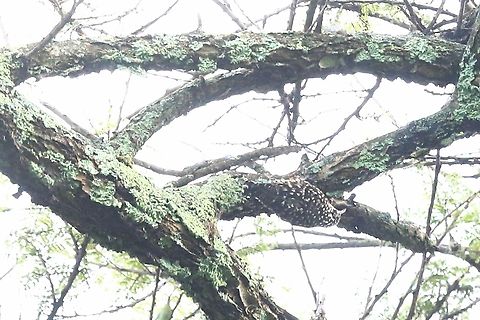
The African spotted creeper has strongly spotted and barred plumage, closely similar to the Indian spotted creeper, but clearly different from the treecreepers in the genus "Certhia". It weighs up to 16 grams, twice as much as treecreepers of similar length [up to 15 cm ].The African spotted creeper has a long, thin, pointed down-curved bill, which it uses to extricate insects from bark, but it lacks the stiff tail feathers which the "Certhia" treecreepers use to support themselves on vertical trees.
Naming
This species and the Indian spotted creeper were formerly considered conspecific and called the spotted creeper. Four distinct subspecies are accepted within the distribution of the African spotted creeper, listed from northwest to southeast:⤷ "S. s. emini" Hartlaub, 1884 – western Africa including Guinea, Sierra Leone, Nigeria, to Cameroon and Chad in the east.
⤷ "S. s. erlangeri" Neumann, 1907 – restricted to the Ethiopian highlands.
⤷ "S. s. salvadori" Bocage, 1878 – eastern Uganda, western Kenya, Tanzania, Malawi and Mozambique.
⤷ "S. s. xylodromus" Clancey, 1975 – the Zambezi Escarpment, Mashonaland Plateau and adjoining Mozambique.
Habitat
Its nests and eggs are quite different from those of treecreepers. The nest is a cup placed on a horizontal branch, usually in a crotch, and camouflaged with spiders' egg sacs, caterpillar frass, and lichen. The clutch is usually of three eggs, which are blue or greenish, marked with grey, lavender, and brown.References:
Some text fragments are auto parsed from Wikipedia.
