Appearance
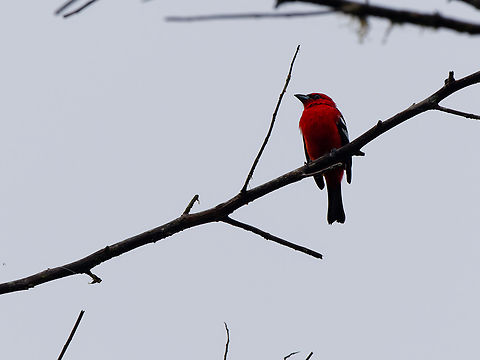
The white-winged tanager is approximately 13 cm long and weighs 13 to 20 g. The nominate male is mostly red, with a black "mask" and black wings with white wing bars. The female is dull olive-yellow, but retains the black wings and white wing bars. The juvenile is similar to the female, but duller. The male "P. l. latifasciata" is darker red and the female a more intense yellow; both sexes have broader white wing bars. The male "P. l. venezuelae" differs from the nominate only in having a smaller "mask". "P. l. ardens" is similar to "venezuelae" but the lower wing bar is narrower.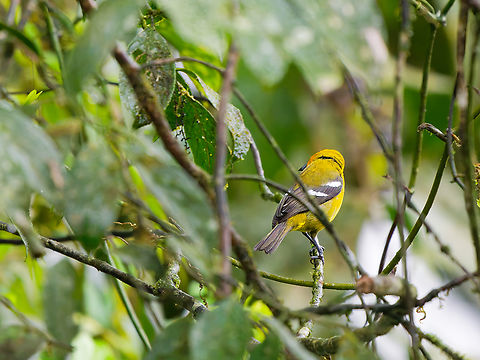
Distribution
The range of white-winged tanager consists of several discontinuous areas. The four subspecies are found thus:⤷ "P. l. leucoptera", from southern Tamaulipas state in Mexico south through Guatemala, Belize, El Salvador and Honduras into north central Nicaragua.
⤷ "P. l. latifasciata", Costa Rica and western Panama.
⤷ "P. l. venezuelae", the Andes of Colombia east through Venezuela into Guyana and far northern Brazil.
⤷ "P. l. ardens", the west slope of the Andes from Nariño in Colombia south to southwestern Ecuador, and the east slope from Ecuador through Peru to Bolivia's Chuquisaca Department.
Status
The IUCN has assessed the white-winged tanager as being of Least Concern. It is found in many protected areas and much of its range outside them also has intact habitat.Habitat
In Mexico and northern Central America the white-winged tanager inhabits pine-oak forest and shady coffee plantations. In the rest of its range it is found in humid montane forest, cloud forest, and mature secondary forest. It also can be found in coffee plantations and drier forest. In Mexico it ranges between 100 and 1,800 m of elevation, though it is mostly found above 600 m on the Atlantic side. In Costa Rica it is found between 1,100 and 1,850 m. In Venezuela north of the Orinoco River it ranges from 650 to 2,100 m and south of the river from 1,000 to 1,800 m. It is found between 600 and 2,000 m in Colombia, Ecuador, and Peru.Reproduction
A female white-winged tanager was documented building a small cup nest high up on a mossy branch. No other information about the species' breeding phenology has been published.Food
The white-winged tanager's diet includes fruit, berries, seeds, and probably insects. Pairs and small groups forage in the forest canopy or edge and may join mixed-species foraging flocks.References:
Some text fragments are auto parsed from Wikipedia.
