Appearance
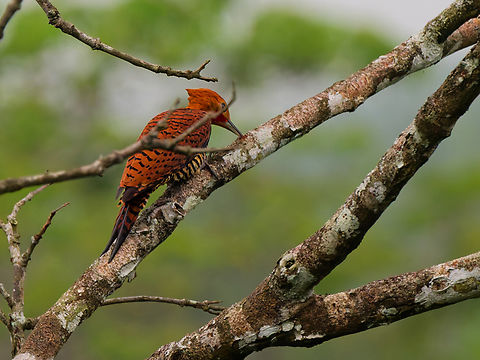
The waved woodpecker is about 23 to 26 cm long and weighs 61 to 87 g. In the nominate subspecies "C. u. undatus", both sexes' heads are light chestnut-rufous with a bushy crest; the crest is sometimes paler with black bars, and the ear coverts and the sides of the neck have black streaks. Males have a wide red band from behind the bill to the ear coverts; females lack it. Both sexes of adults have a cinnamon-buff chin and throat with black spots or bars. They have rufous-chestnut upperparts with wide black bars, though the rump is usually paler and yellower. Their flight feathers are black with cinnamon-rufous bars. The top side of their tail is black with rufous bars and the underside similar but duller and sometimes with a yellowish tinge. Their underparts are rufous, lighter on the belly than the breast. Their breast has irregular wavy black bars and the belly and flanks more regular bars. Both sexes have some variation in the intensity of their barring, but the female's is generally heavier than the male's. The adult's shortish bill is dull yellow to yellow-green, their iris red-brown to red, and their legs green-gray. Juveniles are very similar to adults but duller overall and have lighter barring above.Subspecies "C. u. amacurensis" is darker and more chestnut than the nominate. Its head is the same shade as the body rather than paler, its rump cinnamon-rufous with no yellow, its crown without barring, and all other bars narrower. "C. u. multifasciatus" is the largest subspecies. It is paler and more buffy than the nominate, and has streaks rather than bars on its head, often a tail without bars, and a blackish bill with a pale mandible.
Subspecies "C. u. grammicus" was the nominate subspecies of the former scaly-breasted woodpecker. Both sexes' heads are rufous-chestnut with a pointed crest; the crest usually has black streaks. Males have a wide red patch from behind the bill to the ear coverts; females lack it. Both sexes of adults are mostly rufous-chestnut with a pale greenish-yellow to yellow-buff rump. Their upperparts have narrow black bars that are slighter on the uppertail coverts. Their flight feathers are blackish with narrow rufous edges and pale greenish-yellow bases. The top side of their tail feathers is brown-black with chestnut edges and sometimes chestnut bases; the tail feather's undersides are brown or yellow-brown with cinnamon bases. Their underparts are rufous-chestnut with paler flanks that can be yellowish buff. Their breast has black bars and the belly sparse black spots. The adult's shortish bill is greenish to yellow-green or ivory, their iris red, and their legs dark greenish gray to gray. Juveniles are very similar to adults but their head is darker and their upperparts paler with wider bars.
Compared to "C. u. grammicus", subspecies "C. u. verreauxii" has lighter barring on its underparts. "C. u. subcervinus" is more cinnamon on its rump and flanks, without a yellow tone. "C. u. latifasciatus" has pale cinnamon upperparts with yellow to buffish feather bases that show, and its rump is very pale. The mantle has wider bars than "grammicus" and the underparts are much paler.
Distribution
The subspecies of the waved woodpecker are found thus:⤷ "C. u. amacurensis", northeastern Venezuela's Delta Amacuro state
⤷ "C. u. undatus", eastern Venezuela, Guyana, Suriname, French Guiana and northeastern Brazil north of the Amazon and west of the Rio Negro
⤷ "C. u. multifasciatus", northeastern Brazil south of the Amazon between central Pará and Maranhão
⤷ "C. u. verreauxii", from south-central Colombia into eastern Ecuador
⤷ "C. u. grammicus", from southeastern Colombia and southern Venezuela south to northeastern and eastern Peru and western Brazil as far east as the lower Rio Negro and Rio Purus; also French Guiana
⤷ "C. u. subcervinus", Brazil south of the Amazon between the Rio Purus and the Rio Tapajós and south into Mato Grosso
⤷ "C. u. latifasciatus", southeastern Peru, southwestern Brazil, and northern Bolivia
Status
The IUCN has assessed the waved woodpecker as being of Least concerned. It has a very large range, but its population size is not known and is believed to be decreasing through habitat loss due to deforestation for agriculture and ranching. The waved woodpecker is uncommon and poorly known; it does occur in some protected areas.Habitat
The waved woodpecker primarily inhabits a variety of wooded landscapes including the interior and edges of rainforest, "terra firme" and "várzea" forest, secondary forest, and treed savannah. In most of its range it occurs between 100 and 900 m but is found locally as high as 1,140 m; in Ecuador it reaches only 500 m.Reproduction
The waved woodpecker breeds between late February and April in Venezuela, between late May and August in the Guianas, and possibly earlier and later in Brazil. It excavates the nest cavity in a living or dead tree, typically between 4 and 30 m above the ground. The clutch size, incubation period, time to fledging, and details of parental care are not known.Food
The waved woodpecker's primary food is ants and termites; it also eats sap, seeds, fruits, and berries. It usually forages singly, in pairs, or in small family groups, but does join mixed-species feeding flocks. In the forest interior it forages on tree trunks, branches, and vines from the mid-level to the canopy. It captures prey by pecking, probing, and gleaning.References:
Some text fragments are auto parsed from Wikipedia.
