Appearance
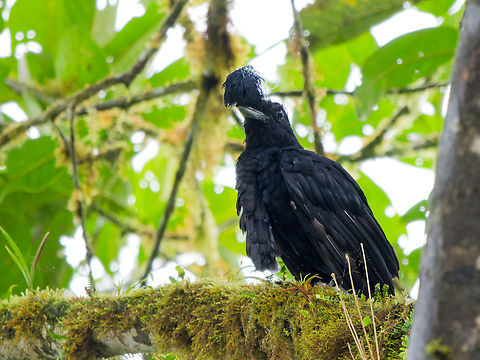
The male is 40–42 cm in height, with the female being slightly smaller at 35–37 cm. Both sexes are short-tailed and carry an erectile head crest; those of the males are slightly longer at 20–30 cm. The male is distinguished by a large throat wattle of feathers, while females and juveniles have no or a much smaller wattle. The length of the wattle can be controlled, and it can be retracted in flight. The male generally has black colored shafts in its feathers.The long-wattled umbrellabird's specific name ''penduliger'' derives from Latin ''pendulus'', hanging, and refers to the wattle.
Distribution
The species shows a high level of endemism and is found from the southwestern part of Colombia to the province of El Oro in Ecuador, in the bioregion of Tumbes–Chocó–Magdalena. It inhabits humid montane forests at 1,500-1,800 m above sea level on the ridges and sides of the Andes range.Status
The species has been classified as vulnerable by the IUCN. A total population of 6,000-15,000 mature individuals was estimated in 2012. It is thought to be under pressure from habitat destruction through deforestation and from hunting. The easy-to-locate lek mating areas make it particularly susceptible to trapping.The long-wattled umbrellabird is present in several protected areas. The consolidation of existing scattered reserves, as well as the nomination of several existing protected areas as biosphere reserves, could be very beneficial for the species. The curating of forest composition and reforestation have been pointed out as important approaches.
Habitat
The species shows a high level of endemism and is found from the southwestern part of Colombia to the province of El Oro in Ecuador, in the bioregion of Tumbes–Chocó–Magdalena. It inhabits humid montane forests at 1,500-1,800 m above sea level on the ridges and sides of the Andes range.Reproduction
The long-wattled umbrellabird engages in lek mating, where the males congregate in common areas for display, which are visited by the solitary females. Females select a male with prominent secondary traits such as aggression and territorial behavior. Nests are built in trees or treeferns, and have been recorded at heights of 4.5–5.0 m above ground.Clutch sizes in the genus ''Cephalopterus'' are generally low; only one egg is laid per nesting attempt. Incubation lasts 27 or 28 days. Only the female incubates and cares for the nestling. She provides food for the nestling on average once per hour and includes invertebrates, vertebrates, and regurgitated material.
Food
The species is mostly frugivorous, and feeds on large fruit. The fruits of the Arecaceae, Lauraceae, and Myrtaceae are preferred. Invertebrates and small vertebrates are also taken.References:
Some text fragments are auto parsed from Wikipedia.
