Appearance
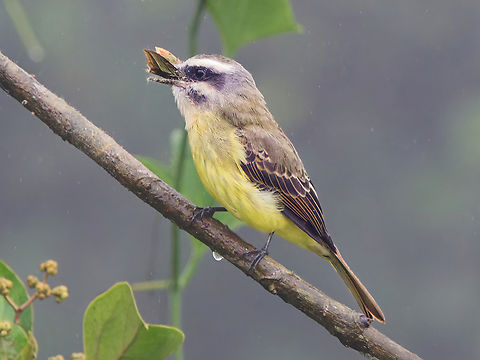
The golden-bellied flycatcher is 20 to 22 cm long and weighs about 39 to 42.5 g. The sexes have the same plumage. Adults of the nominate subspecies "M. h. hemichrysus" have a thinly black-streaked, dusky grayish olive or dark sooty gray, crown and nape with a large, usually hidden, yellow patch in the center of the crown. They have a wide white supercilium, a wide blackish stripe through the lores and ear coverts, and a grayish olive or dusky cheek with a whitish stripe through it. Their upperparts are mostly olive green with a greenish rump and uppertail coverts; the last have cinnamon edges at their tips. Their wings are dusky grayish brown with thin cinnamon or cinnamon-buff edges on the greater coverts. The inner primaries and outer secondaries have thin cinnamon edges and the inner secondaries have wider whitish yellow edges. Their tail is mostly dark grayish brown with wide pale cinnamon or cinnamon-buff edges on the feathers' inner webs. Their chin is whitish, their throat canary-yellow, and rest of their underparts deep lemon-yellow with faint indistinct olive streaks on the breast. Subspecies "M. h. minor" is slightly darker than the nominate with more brownish olive upperparts. "M. h. cinerascens" is essentially the same as the nominate. Juveniles do not have a yellow patch on the crown. They have more brownish olive-green upperparts and paler, slightly buffy underparts than adults. All subspecies have a brown iris, a stout black or brownish black bill with a brownish base to the mandible, and dusky gray legs and feet.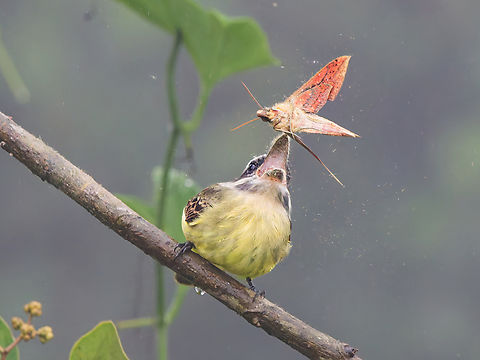
Distribution
The golden-bellied flycatcher has a disjunct distribution. The nominate subspecies is the most northerly of the three. It is found from the Cordillera de Guanacaste in northern Costa Rica south to Veraguas Province in western Panama. Subspecies "M. h. minor" is found from Darién Province in easternmost Panama south through all three ranges of the Colombian Andes and the Andes of Ecuador into Peru north of the Marañon River. "M. h. cinerascens" is found in the Sierra Nevada de Santa Marta in northern Colombia, the Serranía del Perijá on the Colombia-Venezuela border, and in the mountains of western and northern Venezuela from Zulia and Táchira east to Sucre and Monagas states.The golden-bellied flycatcher inhabits the canopy and edges of humid to wet montane forest, especially cloudforest, in the upper tropical and subtropical zones. It is often found along roads and watercourses and at the edges of natural and human-made clearings. It also occurs in plantations and other human-modified habitats. In Costa Rica and Panama it is found between about 800 and 1,800 m on the Caribbean slope and up to 2,300 m on the Pacific slope. It occurs between 1,000 and 2,900 m in Colombia, mostly between 1,000 and 2,200 m in Ecuador, and between 600 and 2,300 m in Venezuela.
Status
The IUCN has assessed the golden-bellied flycatcher as being of Least Concern. It has a very large range; its population size is not known and is believed to be decreasing. No immediate threats have been identified. It is considered fairly common in Costa Rica, common in Colombia and Ecuador, uncommon in Peru, and fairly common in Venezuela.Habitat
The golden-bellied flycatcher has a disjunct distribution. The nominate subspecies is the most northerly of the three. It is found from the Cordillera de Guanacaste in northern Costa Rica south to Veraguas Province in western Panama. Subspecies "M. h. minor" is found from Darién Province in easternmost Panama south through all three ranges of the Colombian Andes and the Andes of Ecuador into Peru north of the Marañon River. "M. h. cinerascens" is found in the Sierra Nevada de Santa Marta in northern Colombia, the Serranía del Perijá on the Colombia-Venezuela border, and in the mountains of western and northern Venezuela from Zulia and Táchira east to Sucre and Monagas states.The golden-bellied flycatcher inhabits the canopy and edges of humid to wet montane forest, especially cloudforest, in the upper tropical and subtropical zones. It is often found along roads and watercourses and at the edges of natural and human-made clearings. It also occurs in plantations and other human-modified habitats. In Costa Rica and Panama it is found between about 800 and 1,800 m on the Caribbean slope and up to 2,300 m on the Pacific slope. It occurs between 1,000 and 2,900 m in Colombia, mostly between 1,000 and 2,200 m in Ecuador, and between 600 and 2,300 m in Venezuela.
Reproduction
The golden-bellied flycatcher's breeding season has not been fully defined but appears to span at least January to July overall. The only well-described nests were shallow open cups made from rootlets and other thin fibers and sometimes included moss. The female alone builds it. Nests have been found between 2 and 30 m above the ground in epiphytes high up on a tree branch, in nooks among roots, and in niches and on ledges on earthen banks and cliff faces. The clutch is two to four eggs. Their color is variable among the subspecies but they generally have a whitish or cream ground with cinnamon, chestnut, or gray speckles and blotches. The incubation period and time to fledging are not known. There is one observation on record of both parents provisioning young; no other details of parental care are known.Food
The golden-bellied flycatcher feeds on insects and fruit; it appears to be partial to adult butterflies and moths. It usually forages in pairs or small family groups and rarely joins mixed-species feeding flocks. It perches from the mid-level to near the crown of a tree and takes prey and fruits mostly with short upward sallies to glean it from vegetation. It takes some insect prey in mid-air by hawking.References:
Some text fragments are auto parsed from Wikipedia.
